




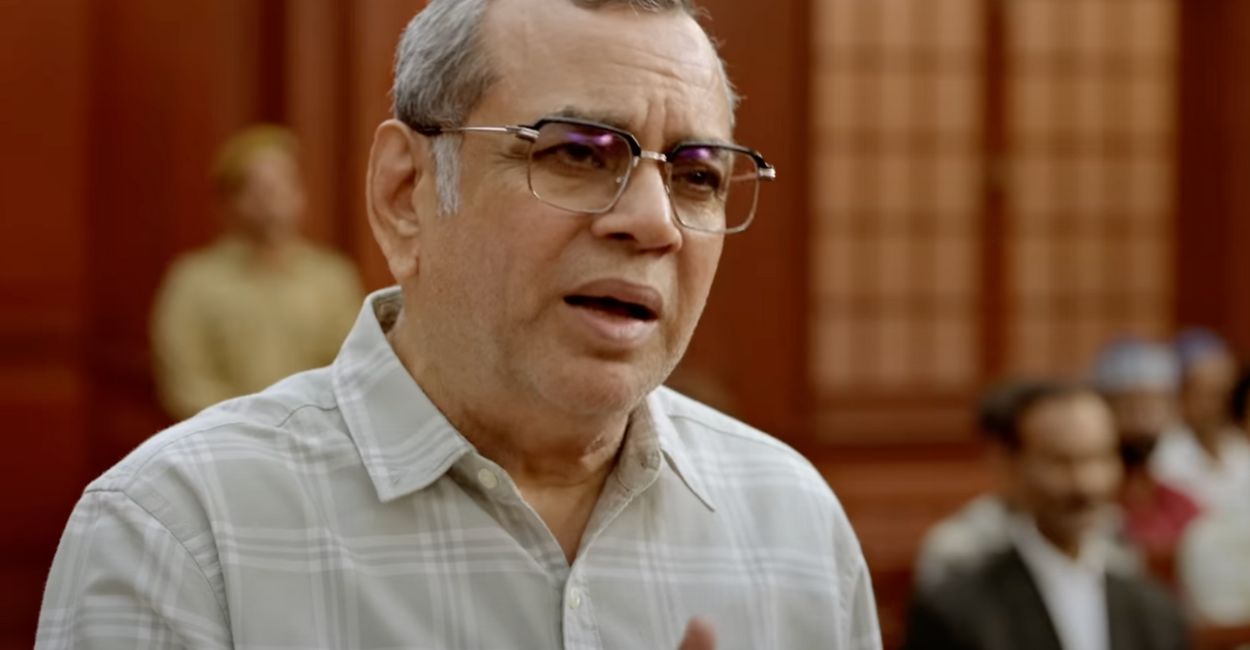
The Taj Story (2025) Review: When Ideology Overshadows Cinema. Tushar Amrish Goel’s The Taj Story (2025), starring veteran actor Paresh Rawal, arrives with a thunderous promise — to question everything we thought we knew about India’s most beloved monument. But what begins as a bold courtroom drama soon turns into a messy ideological battleground that mistakes noise for nuance and debates for drama.
The 165-minute Hindi film wants to be a historical thriller, a courtroom showdown, and a cultural awakening all at once. Yet it ends up being none of them. Instead, it collapses under the weight of its own ambition, trying far too hard to prove a point rather than tell a story.
The Taj Story Review A Premise Built on Controversy
Goel’s film, written with Saurabh M. Pandey, sets out to challenge the accepted history of the Taj Mahal, reviving the long-debunked theory that it was originally a Hindu temple named Tejo Mahalaya. The idea isn’t new — it’s been dismissed by historians, archaeologists, and even the Supreme Court — but the filmmakers push ahead, claiming their goal is to correct “errors in history.”
It’s a gutsy setup, sure, but one that immediately sets off alarm bells. Critics didn’t mince words, calling it “a propaganda film disguised as a courtroom drama,” and “a disjointed mess that fails spectacularly at everything it attempts.”
At the heart of the story is Vishnu Das (Paresh Rawal), an aging Agra tour guide who loses his job after a viral video of him questioning the Taj’s origins sparks outrage. Fueled by wounded pride and a sense of patriotic duty, he files a Public Interest Litigation (PIL) demanding the truth be revealed. What follows is less a gripping legal battle and more a long sermon, stitched together with clunky dialogue and repetitive arguments.
If the film holds together at all, it’s because of Paresh Rawal. Even his harshest critics admit he brings a certain authenticity and emotional depth to Vishnu Das. His accent, his body language, and his conviction feel real. Unfortunately, the role itself isn’t.
Rawal seems trapped in a version of the same character he played in OMG: Oh My God! — the skeptical believer who takes on the system. It’s a formula that once worked brilliantly but now feels recycled. There’s nothing fresh here, and no amount of gravitas can save lines that sound like social-media rants.


Around him, everyone else fades into the background. Zakir Hussain, as the opposing lawyer, barely gets a chance to argue. Amruta Khanvilkar, as a documentary filmmaker, feels like an afterthought. The film sidelines them all, turning the courtroom into a one-man monologue zone where the judge, the audience, and even the camera seem trapped in Vishnu Das’s never-ending speeches.
Pretty Frames, Painful Sound
Visually, there’s something to admire. Cinematographer Satyajit Hajarnis frames the Taj Mahal beautifully — the play of light, the calm reflections, the symmetry. But that’s where the praise stops. The background score, by Rohit Sharma and Rahul Dev Nath, is so overbearing that several critics called it “music torture.”
And while the film looks polished, it sounds and feels excruciatingly long. The endless courtroom scenes, padded with repetitive dialogues about “truth” and “history,” stretch the runtime into an endurance test. What was meant to be fiery becomes flat, what should’ve been emotional becomes exhausting.
Haq Trailer Out Now! Know Full Movie Cast Streaming Release Date
The real problem, though, isn’t cinematic — it’s ideological. The film’s core mission is to push a revisionist narrative, framing the Taj Mahal as a stolen Hindu monument. It borrows heavily from writer P. N. Oak’s discredited theories and cloaks them in patriotic fervor.
There’s nothing subtle about it. The dialogue rails against “leftist historians” and “intellectual terrorism,” while the opposing counsel is visually marked with religious symbols — beards, skull caps, kohl-lined eyes — to make sure the audience knows who the villains are.
When the trailer hinted that the dome of the Taj would open to reveal a Shiva idol, outrage was inevitable. After a wave of criticism, the filmmakers issued a hasty disclaimer claiming the movie “focuses only on historical facts.” But inside the film, the message remains the same — only dressed in slightly more polite language.
Real-World Echoes and Legal Battles
Interestingly, The Taj Story mirrored real life even before its release. In the film, Vishnu Das files a PIL over the monument’s origins. In real life, the Delhi High Court faced a PIL demanding a ban on the movie for distorting history.
The court, led by Chief Justice Devendra Kumar Upadhyaya, refused to intervene, stating that the judiciary wasn’t meant to act as a “Super Censor Board.” It was a moment of irony — a movie about courtroom freedom protected by the very legal system it claimed was suppressing truth.
Another twist came when Dr. Rajneesh Singh, who had filed a 2022 petition to open the Taj’s sealed rooms, accused the filmmakers of stealing his research without consent. That accusation only added fuel to the controversy, making the film’s release on October 31, 2025, feel less like a premiere and more like a political event.
For all its noise, The Taj Story proves surprisingly hollow. It argues loudly but proves little. Despite Rawal’s sincerity and the film’s glossy production, it collapses into what one critic called a “bird-brained pseudo-historical rant.”
What could have been a provocative exploration of faith, history, and identity becomes a shouting match. And while the movie claims to be about truth, it ends up exposing something else — how easily ideology can eclipse art when cinema forgets to tell a story.
A Reflection of the Times
In the end, The Taj Story isn’t memorable for its craft or its courage. It will be remembered as a case study in how pseudo-history seeps into mainstream entertainment — how social-media myths and WhatsApp forwards can evolve into full-scale film scripts.
By trying to rewrite history, the film inadvertently documented a different kind of truth — the uneasy fusion of politics and pop culture. It’s a reminder that while cinema can question power, it loses its power the moment it stops questioning itself. If you want to watch The Taj Story online.
The Review
The Taj Story Movie Review
PROS
- Paresh Rawal’s Committed Performance Rawal brings authenticity and emotional conviction to Vishnu Das. Even when the writing falters, his screen presence and restrained intensity keep the film from completely collapsing.
- Strong Visual Framing of the Taj Mahal Cinematographer Satyajit Hajarnis captures the monument with striking use of light and symmetry. The visual texture often feels more powerful than the film’s dialogue, giving moments of quiet beauty amidst the chaos.
- Courage to Tackle a Controversial Subject Regardless of execution, the film’s willingness to engage with sensitive historical and ideological themes shows ambition. It attempts to provoke conversation — and at times succeeds in doing just that.
CONS
- Ideology Over Storytelling The movie prioritizes political messaging over cinematic craft, turning what could have been an intelligent debate into a slogging lecture. The narrative often sounds like a campaign speech rather than a screenplay.
- Bloated and Repetitive Screenplay At 165 minutes, the film is overlong and structurally disjointed. Endless courtroom monologues replace dramatic tension, leading to fatigue rather than engagement.
- Weak Supporting Characters and Dialogue Despite a capable cast, everyone except Rawal is underused. The dialogues feel clunky and forced, robbing the film of realism and emotional depth.
Review Breakdown
-
Ambitious but hollow — The Taj Story argues loudly yet says little, weighed down by ideology, repetition, and lack of emotional depth. Paresh Rawal shines, but even his sincerity can’t rescue this courtroom of chaos.

