



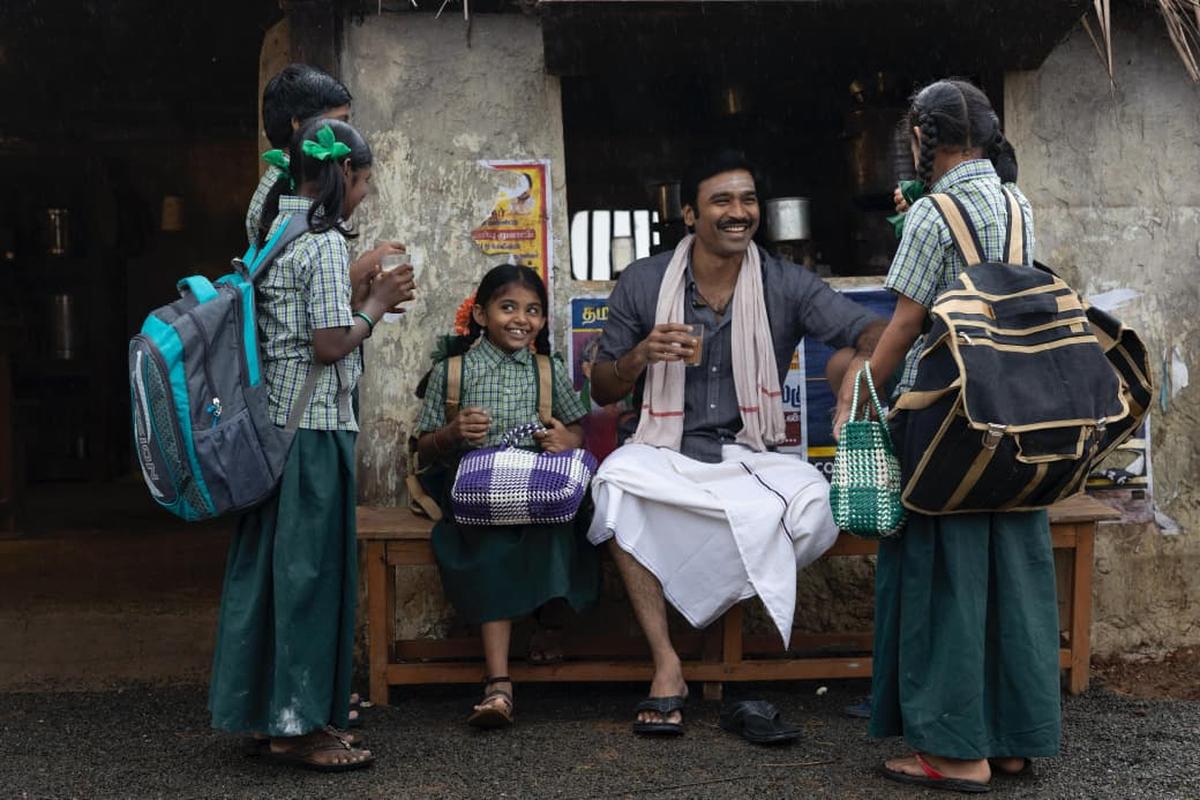
Review: Dhanush’s Idli Kadai is a heartfelt Tamil family drama (available in Hindi on Netflix) that explores the conflict between modern ambition and traditional roots, centered around the titular idli shop in Sankarapuram village. The film follows Murugan (Dhanush), an accomplished chef in Bangkok, who is compelled to return home to his late father Sivanesan’s (Rajkiran) humble legacy.While lauded for its genuine emotional core, particularly the moving father-son relationship and Dhanush’s underplayed performance, the narrative is often criticized for its reliance on clichéd melodrama and a somewhat regressive stance on those who leave their village for better opportunities. Directed by Dhanush, with music by G.V. Prakash Kumar, Idli Kadai ultimately serves as a warm, if over-familiar, comfort meal for audiences seeking stories of family ties and the enduring power of heritage.
From time immemorial, the narrative of homecoming has served as the bedrock of great literature and cinema. It is a quest for identity, a confrontation with the self one left behind, and a reckoning with the sacred ties of blood and soil. In his fourth directorial venture, the multi-hyphenate star Dhanush attempts to pour this ancient, soulful recipe into the simple, steaming mould of a humble breakfast staple: the idli. The result, Idli Kadai, is a film that, much like the dish it celebrates, is supremely comforting, universally appealing, yet, upon closer inspection, a little too soft and perhaps a touch over-steamed.
The movie’s core is built around two fathers, two sons, and two vastly different worlds. On one side, we have Sivanesan (the terrific Rajkiran), the saintly proprietor of the eponymous idli shop in the fictional village of Sankarapuram. To Sivanesan, the craft of making the perfect, fluffiest idli is not a business, but a dharma—a sacred offering made with the intangible magic of kai manam (the taste of one’s hand). On the other, his son Murugan (Dhanush) is the modern archetype: a successful, top-level chef in the corporate kitchens of Bangkok, engaged to the daughter of his billionaire employer, Vishnu Vardhan (a suitably understated Sathyaraj). Murugan represents the seductive pull of global ambition; a desire to trade clean village air and a humble legacy for a ‘developed life’ of luxury cars and concrete towers.
Read more: Idli Kadai: The Timeless Tale of a Steamed Classic—Hit, Flop, or Immortal?
Dhanush, the director and writer, is clearly working from a place of deep personal nostalgia. The film opens with a deliberate, wistful prologue that establishes the sanctity of Sivanesan’s work, subtly hinting at the director’s own affectionate gaze upon the simple life. The cinematic tension is established by the distance between Murugan’s new, polished reality and the earthy, tradition-bound world he fled.
The inciting incident is, predictably, the death of Sivanesan, which compels a guilt-ridden Murugan to return home, days before his corporate wedding. This return is the film’s strongest section. Here, the director weaves in flashes of the spiritual and the magical—a sequence involving a calf that becomes the emotional anchor for Murugan’s grief, and the ethereal omnipresence of his father’s spirit in the familiar sights and sounds of the shop. Rajkiran’s portrayal of Sivanesan is truly the film’s soul, lending an unshakeable gravitas to the concept of simple, honest labour. Murugan’s struggle is beautifully internalised by Dhanush, whose performance is dialed down, a perfect antidote to the high-octane melodrama of the surrounding plot. He embodies a man torn between two promises: the lucrative, albeit hollow, life in Bangkok, and the burden, or perhaps the blessing, of preserving his cultural and culinary heritage.
Where Idli Kadai loses some of its delectable flavour is in its subsequent dependence on formulaic melodrama. The conflict, once Murugan decides to take up his father’s mantle, is externalized into a paint-by-numbers clash with Vishnu Vardhan’s jealous, spoilt-brat son, Ashwin (Arun Vijay). Ashwin’s antagonism is so caricaturish and one-note that it feels less like an organic conflict and more like a necessary screenwriting shorthand to provide dramatic stakes. This pits the “good, moral, non-violent” village hero against the “evil, corrupt, materialistic” city villain, a binary opposition that is not only clichéd but occasionally feels politically regressive.


Critics have rightly pointed out that the film, in its unwavering glorification of rural authenticity, often takes a preachy tone, subtly guilt-tripping those who aspire for a better life outside their ancestral homes, neglecting the nuanced socioeconomic reasons for such migration (Source: The News Minute). The village of Sankarapuram is presented as an almost utopian, conflict-free space, conveniently sidestepping any uncomfortable realities of modern rural life, from caste complexities to occupational rigidities (Source: The New Indian Express).
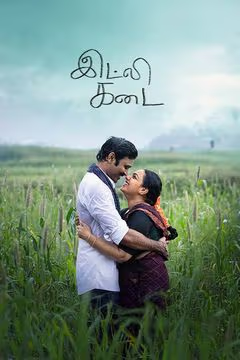
Despite these thematic flaws, the film finds its rhythm in the quieter, heartfelt moments. The burgeoning romance between Murugan and his supportive neighbour, Kayal (Nithya Menen), is a delight. Menen is charming and grounds the romantic subplot with her natural energy, making their scenes a genuine highlight. Furthermore, G.V. Prakash Kumar’s largely ambient soundtrack serves the emotional core well, refusing to overshadow the delicate nature of the story, the ending of Idli Kadai explained here.
Dhanush, the director, proves his command over emotion and pace, even when the writing is simplistic. He uses cinematic flourishes—such as intercutting between timelines or employing magical realism—to underscore loss and memory, a trait that sets him apart from a conventional melodrama director. The final act, which leans heavily into the Gandhian principle of non-violence in the face of escalating tyranny, is well-intentioned but often feels forced, diverting the film from its more compelling emotional thread of personal grief and legacy.
Ultimately, Idli Kadai is a film that plays it safe. It is a heartfelt love letter to a bygone era, a comfort meal made with familiar ingredients, but one that stops short of truly innovating the recipe. It succeeds most when it trusts its actors and its central emotional premise—the profound connection between a father, his son, and the food that bound them. You walk away with a warm feeling, a memory of a simple, comforting flavour, even if you recognise that you’ve tasted this dish many times before. It is a decent, watchable film, but for a filmmaker of Dhanush’s proven talent, one wishes for a dish with a little more spice, a little more depth, and a less predictable garnish.
The Review
Idli Kadai Review
Idli Kadai ultimately serves as a warm, if over-familiar, comfort meal for audiences seeking stories of family ties and the enduring power of heritage.
PROS
- It is a heartfelt love letter to a bygone era.
- a comfort meal made with familiar ingredients, but one that stops short of truly innovating the recipe.
- You walk away with a warm feeling, a memory of a simple, comforting flavour.
CONS
- A decent watchable film, but for a filmmaker of Dhanush's proven talent, one wishes for a dish with a little more spice, a little more depth, and a less predictable garnish.
Review Breakdown
-
Taste of Homecoming
-
Acting for Dhanush's Idli Kadai
-
Setting and overall performance.