





Bugonia, directed by Yorgos Lanthimos and written by Will Tracy, is a Certified Fresh dark comedy thriller starring Emma Stone and Jesse Plemons. Based on the Korean film Save the Green Planet!, it features two conspiracy theorists kidnapping a powerful CEO they suspect is an alien. Critics praise its signature blend of macabre humor and unsettling themes, culminating in one of the most shocking and unforgettable cinematic twists of the year, confirming its status as essential viewing before its wide release on October 31, 2025.
The cinematic landscape is rarely graced by a film that functions simultaneously as a high-concept sci-fi thriller, a razor-sharp political satire, and a deeply unsettling psychological chamber piece. Yorgos Lanthimos’s latest effort, Bugonia, is all three, delivering a potent, if profoundly nihilistic, diagnosis of contemporary societal neurosis. Following the universal acclaim garnered by Poor Things (2023) and Kinds of Kindness (2024), this film marks Lanthimos’s fourth feature collaboration with Emma Stone. It arrives not just as an eagerly anticipated title but as a critical cultural event, premiering at the Venice Film Festival on August 28, 2025, and securing a wide theatrical release through Focus Features on Halloween, October 31, 2025.
The heightened urgency surrounding Bugonia is magnified by the director’s own pronouncement that he intends to take a break from filmmaking following its release. This announcement transforms the film from a standard entry in a formidable filmography into a potential artistic capstone—a statement requiring immediate critical attention. The film is thus scrutinized not merely on its merits, but as a summary of Lanthimos’s career preoccupations: the failure of institutions, the absurdity of human relationships, and the inherent violence underlying social structures.
Bugonia Review
The premise of Bugonia is a modern fable for the Age of Paranoia. It introduces two young, conspiracy-obsessed men who decide to take drastic action. Beekeeper Teddy (Jesse Plemons) and his cousin Don (Aidan Delbis) kidnap Michelle Fuller (Emma Stone), the high-powered CEO of a major company, convinced she is secretly an alien sent to infiltrate humanity and destroy Earth. The film quickly devolves—or ascends—into a bizarre fight for survival and truth, set mostly within the claustrophobic confines of Teddy’s “headquarters of the human resistance”.
The thematic core of Bugonia is the extended, lacerating ideological dialogue that unfolds between the captor and the captive. The film’s power lies not only in the outlandish plot but in how it grounds cosmic conspiracy theory in profoundly personal, societal wounds.
Jesse Plemons, whose performance critics have widely praised as a standout, excels in portraying Teddy Gatz. Plemons navigates his character through a challenging spectrum, showcasing a range that shifts seamlessly from menacing certainty to unsettling vulnerability.2 Teddy embodies the contemporary alienated male, obsessed with global conspiracies, yet deeply wounded by localized corporate malfeasance. His paranoia is meticulously constructed around real-world catastrophes.


Read more: Bugonia (2025) Streaming? Where and When You Might Watch Bong Joon-ho’s Next Sci-Fi Epic
Teddy’s talking points often revolve around the fate of bees and the devastating effects of colony collapse disorder. This environmental fixation, however, is directly linked to his personal grievance against Michelle Fuller’s company, Auxolith, which has a “poisonous history,” including opioid manufacturing that directly affected Teddy’s mother (Alicia Silverstone). By linking the existential, planetary crisis (the dying bees) to the immediate, local tragedy (his mother’s suffering), the film illustrates how conspiracy culture thrives when it correctly identifies genuine corporate harm, even if the resulting theory—that the CEO is an alien—is ludicrous. Teddy’s belief system, though extreme, emerges as a deranged but logical byproduct of systemic failure.
Emma Stone delivers a mesmerizing duality as Michelle Fuller. Initially presented as the “lauded corporate leader”, Michelle’s defense mechanism is a cold, razor-sharp corporate vernacular designed to dehumanize her captors and assert her immense social value. She tells them, “I am crucial, in all humility, I can say that. Think of it you abducted the governor, but worse. There is no possible scenario where you benefit from this incident”.
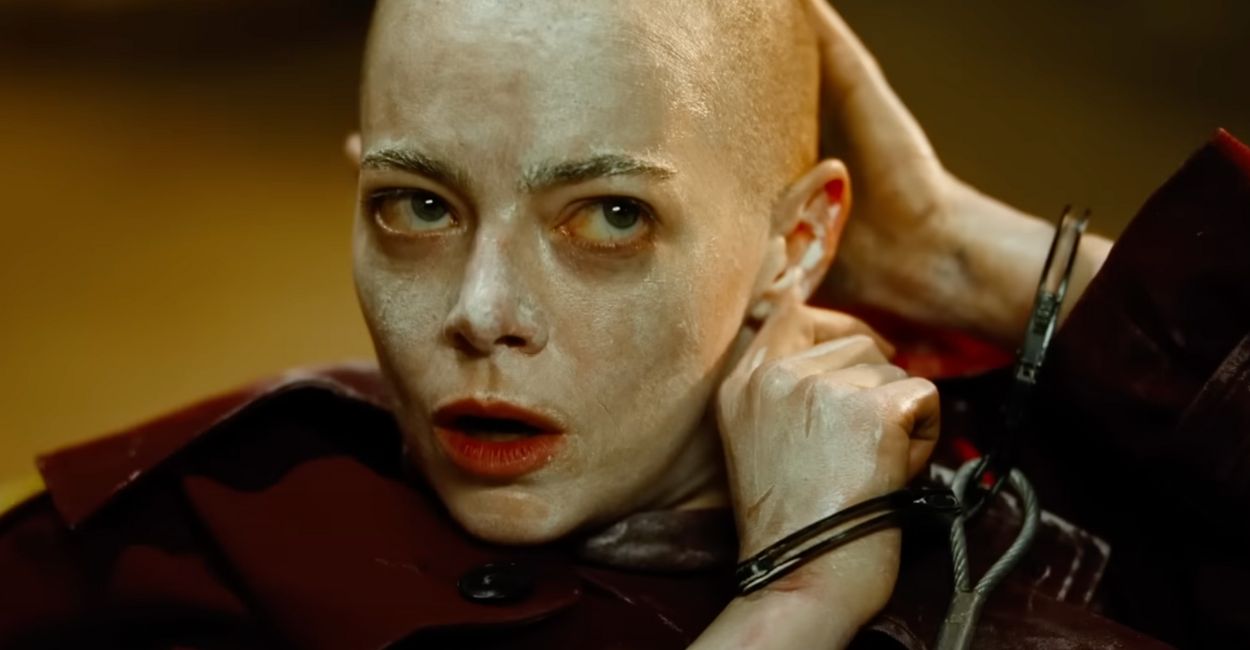
The film establishes itself early on as a “villain vs. villain” narrative. Michelle is ruthlessly driven by the pursuit of wealth, showing zero remorse for the deaths and suffering caused by Auxolith. Conversely, Teddy’s intentions, while ostensibly to save the planet, are rooted in delusion and personalized revenge. This confrontation is surprisingly physical, emphasizing the dehumanization of both characters, particularly Michelle, who, in scenes echoing the original film, is subjected to bizarre treatments while bald and restrained.
The ideological divide that fuels this conflict, which one source notes is “comical for its impossibility”, is the core satirical engine of the film.
The Will Tracy Treatment: A Battle of Wits
Screenwriter Will Tracy, known for his work on Succession and The Menu, provides the textual fuel for this collision. Tracy’s script is noted for its “exquisite dialogue,” which allows Stone and Plemons to wield language as their primary weapon. The conversation is constantly “laced with contemporary divides“—a brilliant collision between Teddy’s paranoia and Michelle’s heartless corporate speak. This adaptation succeeds in transplanting the core premise of the original 2003 South Korean film, Save the Green Planet! 15, into a heightened American context, intensifying the satire by focusing on specific, modern anxieties like the opioid crisis and widespread corporate negligence.
Lanthimos’s distinctive style relies heavily on a team of collaborators who execute his vision of the “eccentric world-building” and “absurdist dark comedy”.8 Bugonia is a testament to this collaborative rigor, particularly the partnership between director of photography Robbie Ryan and production designer James Price, both Oscar-honored artists who previously worked on Poor Things and The Favourite.16
The Grounded Bizarre: Cinematography and Production Design
Robbie Ryan’s cinematography plays a crucial role in establishing the film’s unsettling atmosphere. Lanthimos’s style demands “uniquely framed cinematography” 8, and Ryan achieves this by favoring “super wide” shots. This aesthetic choice often makes the characters appear isolated and small against their environment, amplifying the sense of alienation and observation.
Production designer James Price ensures that the sets are “immersive and full”. Price appreciates that with Lanthimos and Ryan, a remarkable 90% of the production design work makes it onto the screen, unlike many other films where details are lost. This dedication to meticulous design means the setting itself becomes a character, enhancing the film’s macabre energy.
The creation of the basement—Teddy’s “headquarters”—is a masterclass in psychological spatial design. Price treated production design and cinematography as intrinsically linked, crafting a set tailored to naturalistic lighting. The lighting scheme utilized three key sources:
- Natural light: Streaming from high windows, suggesting the constant, silent judgment of the outside world.
- Architectural lighting: Hard strip lights, creating a clinical, interrogation-room atmosphere.
- Practical lighting: From desk, table, and floor lamps, providing a false sense of domesticity within the torture chamber.
This technical precision—using wide shots and meticulously designed, visible sets—deliberately grounds the science fiction narrative in a hyper-realistic world. This strategy enhances the film’s unsettling impact: by making the physical setting entirely believable and observable, Lanthimos forces the viewer to accept the unbelievable scenario unfolding within it. The strange thus becomes real, mirroring how conviction and technical detail in the modern era can lend legitimacy to the most fantastical beliefs.
Soundscape and Performance Style
Further contributing to the atmosphere is the work of composer Jerskin Fendrix (also of Poor Things), who crafts an “eerie and atmospheric banger of a soundscape,” expertly underscoring the film’s tension and absurdity.
In terms of performance, Lanthimos maintains his signature demand for “deadpan acting” and “stilted speech”.8This often humorless delivery of extreme circumstances heightens the dark comedy, ensuring that when the macabre or violent elements appear, they are jarring and deeply felt, rather than simply sensationalized.
Bugonia carries the significant weight of being an English-language remake of Jang Joon-hwan’s cult 2003 masterpiece, Save the Green Planet!. Remakes often face intense scrutiny, and some critics have noted that the original remains “a more formally – and thematically – daring picture”. However, Lanthimos and Tracy succeeded by making the update relevant to contemporary social divides, delivering a film that retains the original’s core structural intensity while injecting fresh satirical venom. The narrative escalation is so bizarre that even those familiar with the source material may be astonished by the plot turns.
The Apocalyptic Final Judgment
The film’s power ultimately rests on its fidelity to the original’s devastating conclusion. As the plot progresses, Teddy’s conviction—that Michelle is an alien tasked with planetary destruction—is revealed to be true. Michelle’s corporate facade cracks, and she is confirmed as the Andromedan empress.
The final sequence is Lanthimos’s most profound and chilling satirical statement. Michelle, after killing Teddy, awakens and teleports into her office closet, which acts as a gateway to the Andromedan mothership. After consulting with her fellow aliens, she delivers a clinical, corporate judgment: the “human experiment is a failure beyond hope”. In a casual, instantaneous act, she pops a bubble over a model of Earth, causing every human being to instantly perish.
This decision to maintain the devastating, definitive ending serves as Lanthimos’s ultimate and most nihilistic corporate satire. Michelle Fuller, the ruthless CEO driven by profit and disconnection, is revealed to be the agent of cosmic genocide. The planetary extinction is not an alien act of malice but the ultimate, cold, and calculated corporate clean-up operation—a simple, logical resolution to a failed product line (humanity). The final shot, of the now-humanless planet where bees slowly return to Teddy’s defunct colony, confirms Teddy’s environmental thesis was correct, even if his methods and specific diagnosis were insane.
Read more: Bugonia Trailer
Bugonia debuted to rave reviews at film festivals, initially securing a perfect 100% on Rotten Tomatoes. Although the score adjusted slightly as more reviews were published, it ultimately achieved a “Certified Fresh” status, settling at a formidable 90-91% with over 85 reviews. The critics’ consensus praises the film as a “bonkers entertainment that applies director Yorgos Lanthimos’ whip-smart method to modern society’s madness,” highlighting the stellar performances of Stone and Plemons. Reviewers commonly describe the film as “bizarre, memorable, entertaining, and surprisingly grounded”.
While the film is critically adored, Metacritic rankings place Bugonia seventh among Lanthimos’s directorial efforts. This demonstrates that while the film is an undeniable success, it operates within the shadow of his highest-rated masterpieces like The Favourite and Poor Things, showcasing the formidable standard Lanthimos has established for himself.
Read more: Bugonia (2025) Streaming? Where and When You Might Watch Bong Joon-ho’s Next Sci-Fi Epic
The Significance of a Sci-Fi Exit
Bugonia is defined by its volatile blend of Science Fiction, Dark Comedy, Thriller, and Crime elements. This genre combination provides Lanthimos with the maximal opportunity to explore his sociopolitical themes of power, exploitation, and institutional collapse with maximal absurdity.
The film functions as an effective thematic and stylistic bridge in Lanthimos’s career. It leverages the commercial viability and star power he achieved during his Oscar run (Stone, Plemons, and an Oscar-winning crew) to deliver the uncompromising nihilism and bleak morality often reserved for his earlier, more niche projects like Dogtooth and Alps. By packaging this profoundly despairing vision—that humanity’s fate is extinction due to its own systemic failures—within a polished, high-concept thriller, Lanthimos confirms his ability to smuggle his bleak world view into the cinematic mainstream. Bugonia is a highly cinematic, disturbing, and deeply funny final statement on the impossibility of human salvation, delivered with a wry, unsettling smile, making it a fitting—if temporary—farewell before his announced hiatus.
The Review
Bugonia Movie Review
Bugonia Review: Yorgos Lanthimos’s Apocalyptic Satire is the Certified Fresh Funeral Rites for Humanity
PROS
- Volatile blend of Science Fiction, Dark Comedy, Thriller, and Crime elements
- The movie delivers the uncompromising nihilism and bleak morality.
CONS
- The movie received criticism on remake of "Save the Green Planet'


